

Ramp Slope and Wheelchairs | Engineering Analysis by SOZI
How Ramp Slope Affects Wheelchairs
When designing an accessible environment, one of the most important engineering parameters is ramp slope.
Even a small difference in slope can significantly affect:
- movement comfort;
- stability;
- safety;
- the physical effort required for movement;
- the risk of wheel blockage;
- the danger of tipping or tripping.
This is especially important for:
- wheelchairs;
- baby strollers;
- pallet trucks;
- cleaning equipment;
- transport equipment.
That is why proper ramp slope is an essential part of modern barrier-free infrastructure.
What EN 17210 Says About Ramp Slope
EN 17210 is a European standard related to accessibility and usability of the built environment.
From an engineering perspective, the main goal of the standard is to ensure:
- smoother transitions;
- reduced physical effort;
- lower dynamic vibration;
- better stability;
- safer movement.
In engineering practice, the following values are commonly considered for ramp slope:
- up to 8% – comfortable slope for long ramps;
- up to 10–12% – acceptable slope for medium transitions;
- up to 15–17% – possible slope for short transitions.
However, it is important to understand one key difference:
A threshold ramp and a cable ramp are usually short transitions rather than long construction ramps.
This means that engineering evaluation in limited spaces is different.
What Bulgarian Accessibility Regulations Define
In Bulgaria, the main principles for an accessible environment are linked to Regulation No. RD-02-20-2.
For long ramps, the following are generally recommended:
- up to 5% – optimal slope;
- up to 8% – acceptable slope;
- up to 12% – allowed in limited spaces.
However, it is important to understand that many threshold ramps and cable crossing ramps belong to the category of short transitions.
This means that engineering analysis is based not only on slope percentage, but also on:
- transition length;
- stability;
- traction;
- movement dynamics;
- real-world usability.
How Ramp Slope Is Calculated
In engineering analysis, slope is calculated using the formula:
Slope (%) = height / length × 100
For example:
A ramp with a height of 5 cm and a length of 41 cm has:
5 / 41 × 100 ≈ 12.2%
This already demonstrates why transition length is so important.
At the same height:
- a longer ramp is more comfortable;
- a shorter ramp is steeper;
- a smoother transition creates less vibration;
- lower dynamic load improves stability.
Why Short Transitions Are the Biggest Problem
Many standard solutions use transitions that are too short.
This leads to:
- abrupt entry;
- strong vibration;
- instability;
- discomfort;
- difficult movement for wheelchairs.
For wheelchairs, transition dynamics are one of the most important factors.
Even if the nominal slope appears acceptable, an excessively short transition may create real usability problems.
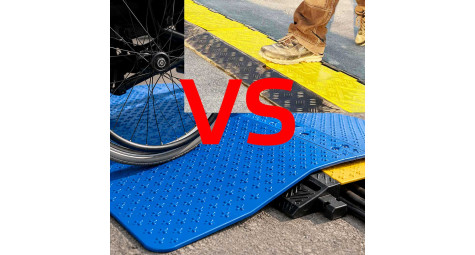
Engineering Analysis of the ADA Ramp PP-KAB-ADA
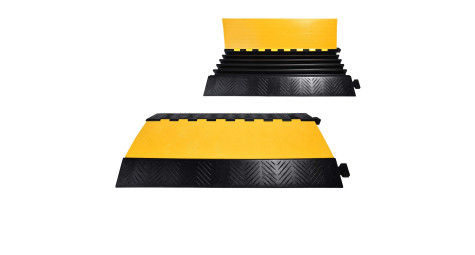
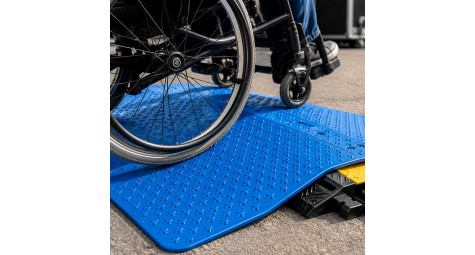
The ADA ramp PP-KAB-ADA was specifically designed for smoother crossing over cable systems.
Main characteristics:
- height: 8 cm;
- total length: 138 cm;
- symmetrical entry and exit;
- length of one transition: approximately 69 cm.
According to engineering calculations:
Slope = 8 / 69 × 100 ≈ 11.6%
This value is significantly more comfortable compared to many short and abrupt transitions found in standard cable protectors.
The longer transition provides:
- less vibration;
- more stable movement;
- more comfortable crossing;
- reduced trip risk;
- better accessibility.
The Difference Between Threshold Ramps and Cable Ramps
A threshold ramp and a cable ramp follow similar engineering logic — both are designed to overcome height differences in limited spaces.
However, there are important differences.
A threshold ramp is usually:
- fixed;
- monolithic;
- part of permanent infrastructure.
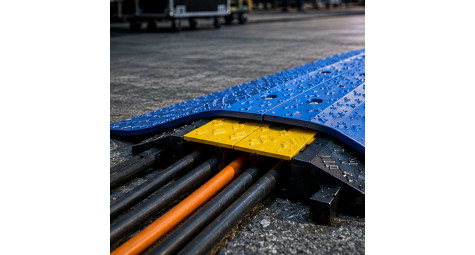
A cable ramp is usually:
- temporary;
- modular;
- connected to cable routes;
- used at events and infrastructure projects.
In both cases, however, the engineering goal remains the same:
smoother and safer crossing.
What Real Engineering Accessibility Means
Real accessibility does not simply mean having a ramp.
An engineering-based barrier-free environment means:
- truly usable space;
- stable movement;
- reduced physical strain;
- less vibration;
- lower trip risk;
- more comfortable movement.
That is why professional ADA ramps and engineering-calculated transitions are becoming increasingly important in modern infrastructure.
SOZI – Engineering Solutions for Accessible Infrastructure and Safe Crossing
SOZI develops professional solutions for accessible infrastructure, engineering safety, and smooth crossing in temporary and permanent infrastructure projects.
Our solutions are used at:
- stages and festivals;
- public spaces;
- sports events;
- logistics centers;
- temporary infrastructure projects;
- areas with cable routing.
A professional engineering approach to ramp slope, ADA ramps, and barrier-free infrastructure is an important part of modern safety and real accessibility.