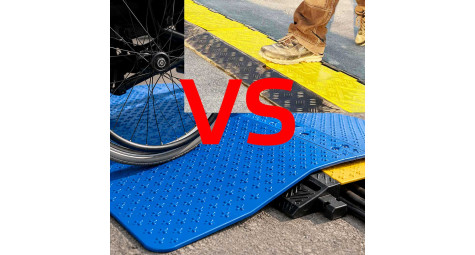


Engineering Analysis of Cable Protectors and Wheelchairs | SOZI
Why Standard Cable Protectors Are a Problem for Wheelchairs
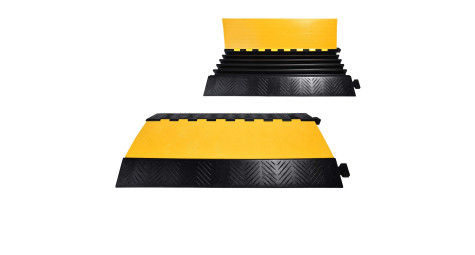
Most standard cable protectors are designed primarily for cable protection rather than real accessibility for wheelchairs.
In practice, this means that many spaces may appear organized and safe, while in reality creating serious difficulties for people with reduced mobility.
This problem becomes especially visible at:
- festivals;
- stages;
- concerts;
- public spaces;
- temporary events;
- exhibitions;
- sports events.
In such environments, the issue of barrier-free infrastructure is no longer only about comfort, but about real safety and engineering accessibility.
The Main Problem – Steep Slope and Short Transition
Most standard cable protectors have a relatively high center section and short ramp transitions.
This creates:
- abrupt transitions;
- strong vibrations;
- instability;
- discomfort;
- trip hazards;
- difficult movement for wheelchairs.
For a person without mobility limitations, such a transition may seem insignificant.
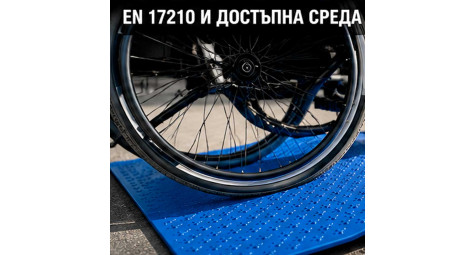
For wheelchairs, however, even a small difference in slope and transition length can significantly affect stability and movement comfort.
How Slope Affects Wheelchairs
In engineering analysis of an accessible environment, one of the most important parameters is transition slope.
The slope is calculated using the formula:
Slope (%) = height / length × 100
The shorter the transition at the same height, the steeper the crossing becomes.
This leads to:
- stronger vibrations;
- greater instability;
- higher risk of wheel blockage;
- greater physical effort;
- increased trip hazards.
In a barrier-free environment, a smooth transition is one of the most important safety factors.
Engineering Analysis of the ADA Ramp PP-KAB-ADA
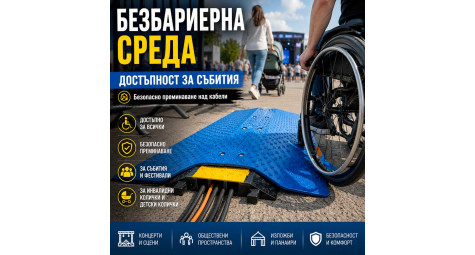
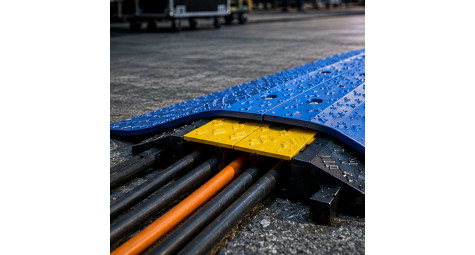
The ADA ramp PP-KAB-ADA was specifically designed for smoother crossing over cable systems.
Main parameters:
- height: 8 cm;
- total length: 138 cm;
- symmetrical entry and exit;
- length of one transition: approximately 69 cm.
According to engineering calculations, the ramp slope equals:
Slope = 8 / 69 × 100 ≈ 11.6%
This value is significantly more comfortable compared to many short standard transitions commonly found in conventional cable protectors.
The longer transition provides:
- smoother crossing;
- less vibration;
- better stability;
- reduced trip risk;
- more comfortable wheelchair movement.
What European Accessibility Principles Show
When designing a barrier-free environment, European accessibility principles encourage the use of:
- smoother transitions;
- lower dynamic vibration;
- more stable movement;
- reduced obstacle risk;
- higher safety levels.
Especially at temporary events and spaces with cable routes, engineering logic focuses on reducing abrupt transitions and improving movement comfort.
This is one of the reasons why a professional ADA ramp provides significantly better accessibility than standard solutions.
Trip Hazards Created by Standard Cable Protectors
One of the most common problems with unsuitable cable protectors is increased trip hazard.
This is especially critical in:
- high-traffic areas;
- dark environments;
- temporary events;
- evacuation routes;
- areas with carts and equipment traffic.
The steep geometry of some standard solutions can create instability not only for wheelchairs, but also for:
- baby strollers;
- pallet trucks;
- elderly people;
- cleaning machines;
- transport equipment.
What Professional Accessibility Looks Like for Cable Routes
Professional accessibility is not simply about covering cables, but about engineering the crossing itself.
A high-quality ADA ramp should provide:
- smooth slope;
- wide entry;
- stable surface;
- good traction;
- high visibility;
- compatibility with cable systems.
This is especially important in a modern accessible environment, where safety and real usability are equally important.
Why This Topic Is Becoming Increasingly Important
Modern events and public spaces are placing greater emphasis on real accessibility.
Visitors expect:
- safer environments;
- fewer obstacles;
- more comfortable movement;
- better space organization;
- truly barrier-free infrastructure.
That is why engineering solutions for wheelchairs, smooth transitions, and professional ADA ramps are becoming an increasingly important part of modern infrastructure.
SOZI – Engineering Solutions for Barrier-Free Infrastructure and Safe Crossing
SOZI develops professional solutions for barrier-free infrastructure, safe cable crossing, and engineering accessibility in temporary and permanent spaces.
Our solutions are used at:
- stages and festivals;
- public spaces;
- sports events;
- logistics centers;
- infrastructure projects;
- temporary events.
A professional ADA ramp and proper organization of cable protectors are an important part of modern safety, engineering logic, and real accessibility.