


Accessible Infrastructure and Safe Cable Crossing | SOZI
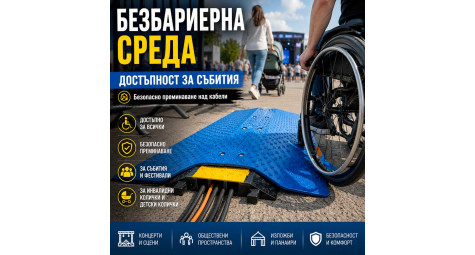

Accessible Infrastructure and Safe Cable Crossing – A New Standard for Modern Infrastructure
Modern public spaces, stages, festivals, sports events, and temporary infrastructure projects increasingly require not only cable protection, but also truly accessible infrastructure.
In areas with high pedestrian traffic, safe cable crossing has already become an important part of:
- safety;
- space organization;
- accessibility;
- visitor comfort;
- trip hazard reduction;
- reliable infrastructure operation.
This is especially important for:
- wheelchairs;
- baby strollers;
- temporary events;
- public spaces;
- stages and festivals;
- sports events;
- airports and railway stations;
- shopping centers;
- areas with temporary cable routes.
That is why professional ADA ramps, cable protectors, and engineering solutions for safe cable crossing are becoming an increasingly important part of modern infrastructure.
What Modern Accessible Infrastructure Means
Today, accessible infrastructure means much more than simply having a ramp at an entrance.
Modern engineering accessibility includes:
- safe crossing;
- smoother transitions;
- stable surfaces;
- efficient space organization;
- reduced obstacles;
- more comfortable movement;
- lower trip hazards.
At temporary events, cable routes often become the biggest obstacle to creating a truly barrier-free environment.
Standard cables placed across floors can create:
- difficult crossing;
- instability;
- trip hazards;
- risks for wheelchairs;
- evacuation problems;
- equipment damage.
Why Safe Cable Crossing Is Becoming Critically Important
Stages, festivals, and temporary infrastructure projects often involve dozens or even hundreds of meters of cable routes.
These cables provide:
- power supply;
- lighting;
- audio systems;
- communications;
- temporary technical connections.
Without professional organization, however, they become a serious safety risk.
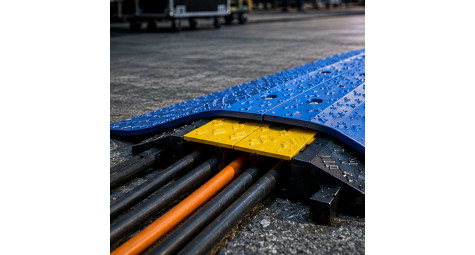
This is where professional cable protectors and cable ramps play a critical role.
They help provide:
- cable protection;
- safer crossing;
- better organization;
- higher visibility;
- reduced accident risk.
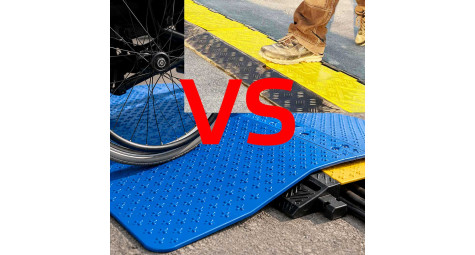
What Is the Difference Between a Standard Cable Protector and an ADA Ramp
A standard cable protector is primarily designed for cable protection.
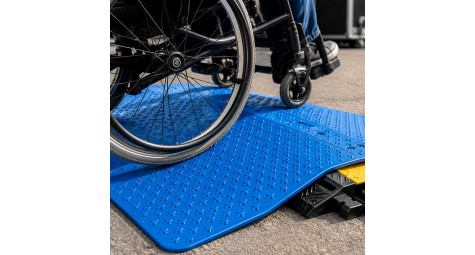
An ADA ramp adds another important feature:
smoother and more comfortable crossing for wheelchairs and visitors.
The main difference lies in the transition geometry.
Many standard cable protectors feature:
- steeper slopes;
- shorter transitions;
- stronger vibration;
- higher trip hazards.
An ADA ramp uses:
- longer transitions;
- smoother slopes;
- better stability;
- more comfortable movement.
This is especially important in environments with:
- wheelchairs;
- baby strollers;
- high pedestrian traffic;
- public events.
How Ramp Slope Affects Wheelchairs
In engineering analysis of accessible infrastructure, one of the most important parameters is ramp slope.
Slope is calculated using the formula:
Slope (%) = height / length × 100
The shorter the transition at the same height, the steeper the crossing becomes.
This leads to:
- stronger impacts;
- greater vibration;
- higher dynamic load;
- greater instability risk;
- more difficult wheelchair movement.
The PP-KAB-ADA model features:
- height: 8 cm;
- total length: 138 cm;
- single transition length: approximately 69 cm.
The engineering calculation shows:
Slope = 8 / 69 × 100 ≈ 11.6%
This longer transition provides:
- smoother movement;
- less vibration;
- better stability;
- lower trip hazards;
- more comfortable crossing.
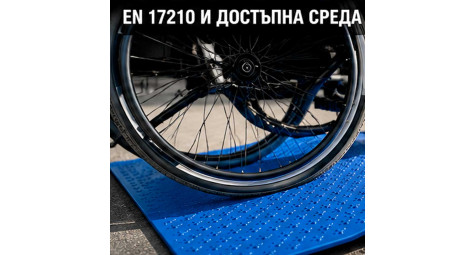
EN 17210 and the Engineering Logic of Accessibility
The European standard EN 17210 focuses on real-world usability and safe movement within built environments.
In the engineering logic of the standard, the key factors include:
- smooth transitions;
- stability;
- safe movement;
- reduced obstacles;
- lower dynamic vibration.
This is especially important for:
- wheelchairs;
- public spaces;
- temporary infrastructure;
- stages and festivals.
In engineering accessibility, simply installing a ramp is not enough. Real safety and comfort during movement are what truly matter.
Where ADA Ramps and Professional Cable Protectors Are Used
Professional solutions for safe cable crossing are widely used at:
- festivals;
- stages;
- concerts;
- sports events;
- public spaces;
- airports;
- railway stations;
- shopping centers;
- logistics centers;
- temporary infrastructure projects.
In these environments, safety, accessibility, and reliable cable management are critically important.
What Problems Inappropriate Solutions Create
Inappropriate cable protectors may lead to:
- trip hazards;
- instability;
- strong vibration;
- discomfort for wheelchairs;
- cable damage;
- poor space organization.
At large-scale events, these issues can affect the overall safety of the environment.
What You Will Find in This Category
In this category, you will find professional materials about:
- ADA ramps;
- cable protectors;
- cable ramps;
- engineering accessibility;
- ramp slope;
- trip hazards;
- safe cable crossing;
- accessible infrastructure;
- barrier-free environments;
- temporary infrastructure.
This category was created as a professional information hub for modern infrastructure, engineering safety, and real accessibility.
SOZI – Professional Solutions for Accessibility and Engineering Safety
SOZI develops professional solutions for:
- ADA ramps;
- cable protectors;
- accessible infrastructure;
- engineering safety;
- temporary infrastructure;
- safe cable crossing.
Our solutions are used in public spaces, on stages, at festivals, in logistics centers, and at infrastructure projects where safety and accessibility are critically important.


