

How to Calculate the Required Number of Speed Bump Sections
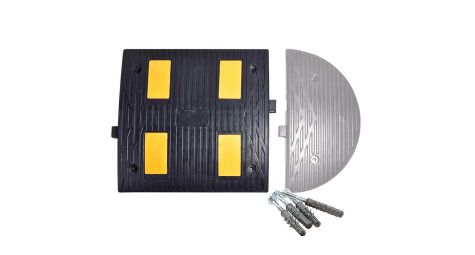
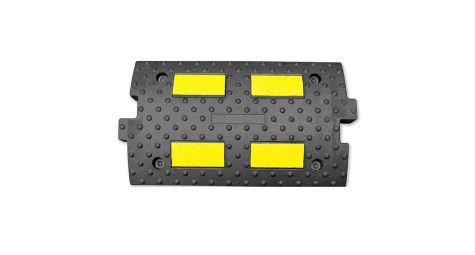
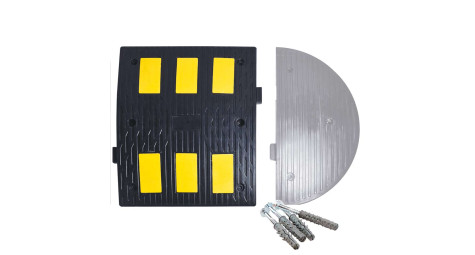
Before installing a modular rubber speed bump, it is important to calculate the correct number of centre modules and end caps. Simply dividing the road width by the width of one centre module is not enough because every complete speed bump installation also requires two end caps — one on each side.
A proper calculation helps you select the right configuration for the actual width of a road, vehicle entrance, warehouse access, parking area or industrial driveway. The assembled speed bump must fit within the available installation space while taking kerbs, drainage channels, road surface conditions and installation requirements into account.
The calculator on this page has been developed for the LP07, LP04-500 and LP05-600 modular rubber speed bump models. Simply select the required model and enter the actual width of the vehicle access in metres.
The calculator automatically determines the recommended number of centre modules, the required end caps, the overall width of the assembled speed bump and the remaining free space.
Calculate the Required Number of Speed Bump Modules
Select a model and enter the width of the vehicle access. The calculator will determine the number of centre modules, two end caps, the total assembled width and the remaining free space.
1. Select a model
2. Enter the vehicle access width
Measure the actual width of the road, entrance or vehicle access at the point where the speed bump will be installed.
LP07
500 mm each
150 mm each
of the assembled speed bump
—
Calculated configuration
Calculation summary
Alternative configuration with more free space
How Does the Speed Bump Calculator Work?
First, choose the required speed bump model. Then enter the actual width of the road, entrance, warehouse aisle, parking lane or other vehicle access.
The calculator will automatically display:
- the selected model;
- the centre module dimensions;
- the width of one centre module within the assembled speed bump;
- the width of one end cap;
- the required number of centre modules;
- two end caps;
- the total assembled width;
- the remaining free space;
- the free space on each side when the speed bump is centred.
Available Models
| Model | Centre Module Size | Centre Module Width | End Cap Width | Total Width of Two End Caps |
|---|---|---|---|---|
| LP07 | 300 × 500 × 55 mm | 500 mm | 150 mm | 300 mm |
| LP04-500 | 500 × 500 × 45 mm | 500 mm | 250 mm | 500 mm |
| LP05-600 | 600 × 500 × 45 mm | 500 mm | 300 mm | 600 mm |
The first dimension indicates the module length in the direction of vehicle travel, the second indicates the module width across the road, and the third indicates the height of the speed bump.
How Is the Total Width Calculated?
For all three models, every centre module contributes 500 mm to the total width of the speed bump. The only difference between the models is the width of the matching end caps.
LP07 Calculation
Each LP07 end cap is 150 mm wide. Together, the two end caps occupy 300 mm.
Total Width = (Number of Centre Modules × 500 mm) + 300 mm
LP04-500 Calculation
Each LP04-500 end cap is 250 mm wide. Together they occupy 500 mm.
Total Width = (Number of Centre Modules × 500 mm) + 500 mm
LP05-600 Calculation
Each LP05-600 end cap is 300 mm wide. Together they occupy 600 mm.
Total Width = (Number of Centre Modules × 500 mm) + 600 mm
Why Are Two End Caps Required?
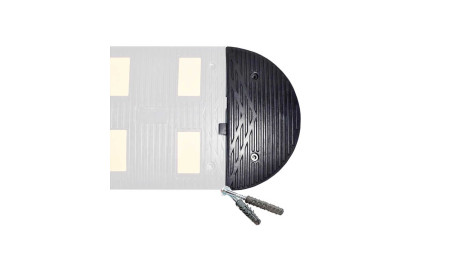
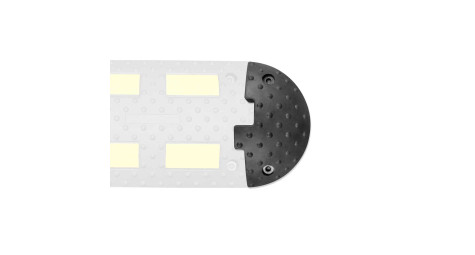
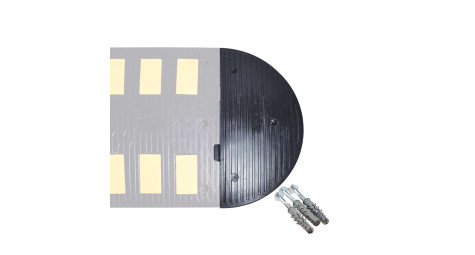
End caps complete the speed bump on both sides. They are specially designed finishing sections and are not additional centre modules.
Every complete modular speed bump always consists of two end caps — one left and one right.
End caps provide several important functions:
- they create a smoother entry and exit for vehicles;
- they finish the outer edges of the installation;
- they protect the outer centre modules;
- they improve safety by eliminating exposed edges;
- they give the installation a professional finished appearance.
Should a Speed Bump Cover the Entire Width of the Road?
On car parks, warehouse sites, industrial facilities, residential developments and private roads, a modular speed bump is not usually installed from kerb to kerb.
In most cases, a small amount of free space is intentionally left on both sides of the installation. This is often considered the best engineering solution.
The remaining clearance may be required for:
- rainwater drainage;
- surface water channels;
- road cleaning equipment;
- clearance from kerbs or walls;
- small measurement tolerances;
- future maintenance or replacement of individual modules.
There is no universal side clearance that is suitable for every installation. The required gap depends on the road surface, drainage system, kerbs and the specific conditions of the project.
How Does the Calculator Choose the Best Configuration?
The calculator automatically selects the largest standard configuration that does not exceed the entered road width.
This guarantees that the assembled speed bump will fit within the available installation area.
The calculator also displays the remaining free space. When the speed bump is installed centrally, the remaining space is divided equally between both sides.
Important. The calculator provides an estimated result only. Before ordering or installing a modular speed bump, always verify the actual road width, kerb locations, drainage system, road surface condition and any site-specific requirements.
Calculation Example
Assume that the road width is 4.35 m and the selected model is LP05-600.
The two end caps occupy a total width of 0.60 m, leaving 3.75 m available for the centre modules.
Since every centre module has a width of 0.50 m, seven centre modules can be installed.
7 × 0.50 m + 0.60 m = 4.10 m
After installation, 0.25 m of free space remains, which equals approximately 12.5 cm on each side when the speed bump is positioned in the centre of the road.
The recommended configuration is:
- 7 LP05-600 centre modules;
- 2 LP05-600 end caps;
- overall speed bump width: 4.10 m;
- remaining free space: 0.25 m.
What Information Is Required?
Measure the actual width of the location where the speed bump will be installed. Measurements should always be taken directly at the installation point.
Examples:
- 2.80 m;
- 3.50 m;
- 4.25 m;
- 5.00 m.
Next, select LP07, LP04-500 or LP05-600. The calculator automatically applies the correct end-cap dimensions for the selected model.
Frequently Asked Questions
How many end caps are required?
Every complete modular speed bump requires two end caps — one on each side.
What is the width of one centre module?
For all three models — LP07, LP04-500 and LP05-600 — every centre module adds exactly 500 mm to the overall installation width.
Are the end caps interchangeable?
No. Each model has its own dedicated end caps. LP07, LP04-500 and LP05-600 use different end sections.
Can a speed bump be installed without end caps?
Although the centre modules can physically be connected together, the standard factory configuration always includes two matching end caps.
What happens if the road width is not divisible by the module width?
The calculator automatically selects the largest configuration that fits within the entered road width. The remaining difference is displayed as free space.
Why doesn't the calculator round the number of modules up?
Rounding up could produce a speed bump wider than the available installation area. The calculator therefore always selects the maximum configuration that fits safely within the specified width.
Is the fixing hardware included?
Yes. Mounting hardware is supplied according to the standard configuration of the selected model.
Can this calculation be used for public roads?
The calculator is intended only to estimate the required number of modular components. Installation on public highways must always comply with local regulations, approved traffic management plans and the requirements of the responsible road authority.
Order Modular Rubber Speed Bumps from SOZI
After completing the calculation, you can order the required number of centre modules and end caps directly from the SOZI online store.
Always use components from the same product series:
- LP07 centre modules with LP07 end caps;
- LP04-500 centre modules with LP04-500 end caps;
- LP05-600 centre modules with LP05-600 end caps.
SOZI maintains permanent stock of modular rubber speed bumps and supplies both small and large orders for parking facilities, warehouses, industrial sites, logistics centres, residential developments and private roads.