

Standard Cable Protector or ADA Ramp | Engineering Comparison by SOZI
Standard Cable Protector vs ADA Ramp – Why the Difference Is Much Bigger Than It Seems
When organizing stages, festivals, public spaces, and temporary events, cable protectors are widely used to protect cable routes.
However, in recent years, one important question has become increasingly common:
Is a standard cable protector sufficient, or is an ADA ramp necessary?
At first glance, both solutions appear similar. Both cover cables and allow crossing over cable routes.
In real-world use, however, the difference between a standard cable protector and an ADA ramp is enormous.
Especially for:
- wheelchairs;
- baby strollers;
- public spaces;
- temporary events;
- stages;
- festivals;
- areas with high pedestrian traffic.
The Main Purpose of a Standard Cable Protector
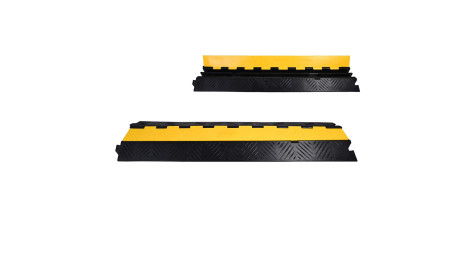
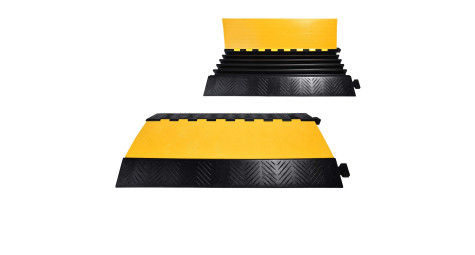
A standard cable protector was primarily designed for:
- cable protection;
- preventing mechanical damage;
- organizing cable routes;
- allowing people and equipment to cross safely.
It is an excellent solution for:
- warehouses;
- logistics centers;
- industrial facilities;
- technical zones;
- stages;
- temporary technical routes.
However, a standard cable protector is usually not specifically engineered for wheelchairs and accessibility requirements.
The Main Purpose of an ADA Ramp
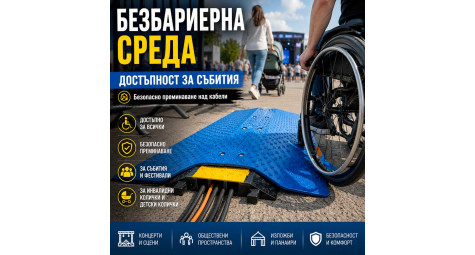
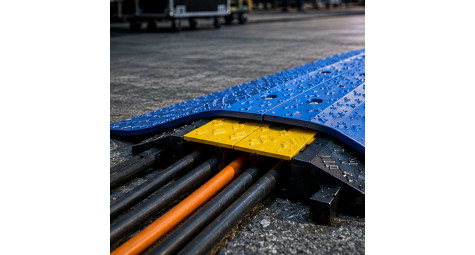
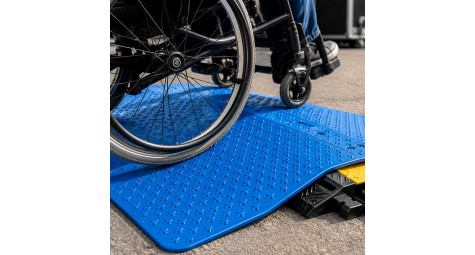
An ADA ramp was developed for smoother and safer crossing over cable systems.
Its primary goals are:
- reducing abrupt transitions;
- creating smoother movement;
- reducing vibration;
- improving stability;
- lowering trip hazards;
- improving accessibility.
This makes it significantly more suitable for:
- wheelchairs;
- baby strollers;
- public spaces;
- temporary events;
- areas with accessibility requirements.
The Engineering Difference in Transition Slope
The main difference between a standard cable protector and an ADA ramp is the transition geometry.
In many standard solutions, the transition is:
- shorter;
- steeper;
- associated with stronger dynamic vibration;
- associated with a higher instability risk.
With an ADA ramp, the transition is significantly smoother.
For example, the PP-KAB-ADA model features:
- height: 8 cm;
- total length: 138 cm;
- single transition length: approximately 69 cm.
The engineering calculation shows:
Slope = 8 / 69 × 100 ≈ 11.6%
This longer transition provides:
- smoother movement;
- less shock and vibration;
- better stability;
- more comfortable crossing;
- lower trip risk.
This is one of the main reasons why a professional ADA ramp is significantly better suited for wheelchairs.
Comparison Between a Standard Cable Protector and an ADA Ramp
| Parameter | Standard Cable Protector | ADA Ramp |
|---|---|---|
| Main Function | Cable protection | Smooth and accessible crossing |
| Wheelchair crossing | Often difficult | Significantly more comfortable |
| Transition slope | Steeper | Smoother |
| Vibration | Stronger | Lower |
| Trip hazard | Higher | Lower |
| Suitable for accessibility | Limited | Yes |
| Crossing comfort | Medium | Higher |
| Suitable for public spaces | Partially | Yes |
Why Trip Hazard Is So Important
In areas with high pedestrian traffic, trip hazards become a serious issue.
This is especially relevant for:
- dark areas;
- festivals;
- concerts;
- evacuation routes;
- public events;
- temporary installations.
The steeper the transition, the higher the risk becomes.
That is why solutions designed for:
- smoother transitions;
- better stability;
- less vibration;
- reduced trip hazards;
are becoming increasingly important in modern infrastructure.
When a Standard Cable Protector Is the Right Choice
A standard cable protector is an excellent solution for:
- warehouses;
- logistics centers;
- forklifts;
- technical zones;
- industrial routes;
- areas without accessibility requirements.
It provides reliable cable protection and high load capacity.
When an ADA Ramp Is the Better Solution
An ADA ramp is the better solution for:
- wheelchairs;
- public spaces;
- festivals;
- concerts;
- stages;
- temporary events;
- accessible environments;
- areas with high pedestrian traffic.
In these environments, smoother transitions and lower trip risk are critical for safety and comfort.
SOZI – Professional Solutions for Cable Routes and Accessible Infrastructure
SOZI develops professional solutions for:
- cable protectors;
- ADA ramps;
- safe cable crossings;
- accessible infrastructure;
- engineering safety;
- temporary infrastructure projects.
The professional choice between a standard cable protector and an ADA ramp depends on the operating environment, expected load, and required accessibility level.