

Frequently Asked Questions About Traffic Mirrors - SOZI
Frequently Asked Questions About Traffic Mirrors
What is the difference between acrylic and polycarbonate?
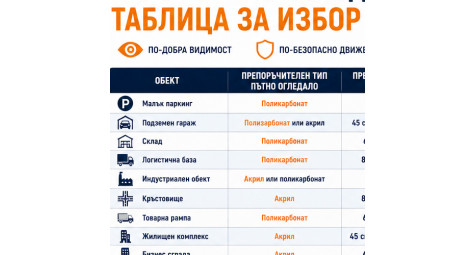
Polycarbonate traffic mirrors are more practical and more impact-resistant, making them highly suitable for warehouses, industrial facilities, loading ramps, and working environments with a higher risk of mechanical impact.
Acrylic traffic mirrors provide clearer reflections, better optical clarity, and higher visual comfort. They are often used in parking areas, intersections, office buildings, and representative facilities.
Both types of traffic mirrors are suitable for professional use — the choice depends on the specific facility and operating conditions.
Which mirror is more impact-resistant?
Polycarbonate traffic mirrors are generally more impact-resistant and more practical for industrial environments.
They are suitable for:
- warehouses;
- logistics centers;
- loading ramps;
- forklift traffic zones;
- facilities with a risk of mechanical impact.
Acrylic traffic mirrors provide higher reflection quality and better visual comfort.
Which traffic mirror should I choose for a parking area?
For a standard parking area, a 60 cm traffic mirror is most commonly used.
For larger parking facilities or heavier traffic, an 80 cm traffic mirror is often a more suitable choice.
If you are looking for a more professional solution with clearer reflections, an acrylic traffic mirror is a good option.
For standard everyday applications, a polycarbonate traffic mirror is also a very practical and efficient solution.
What size traffic mirror do I need?
The size depends on the viewing distance and the width of the area.
- 45 cm – up to approximately 10 m;
- 60 cm – up to approximately 22 m;
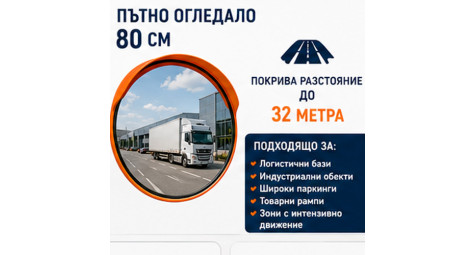
- 80 cm – up to approximately 32 m;
- 100 cm – up to approximately 37 m.
The larger the observation area, the larger the traffic mirror required.
Are traffic mirrors suitable for outdoor installation?
Yes. Traffic mirrors are designed for outdoor installation and are widely used in:
- parking areas;
- intersections;
- internal roads;
- industrial facilities;
- loading zones;
- logistics centers.
It is important that the traffic mirror is installed correctly and securely fixed to a suitable structure.
How is a traffic mirror installed?
Most traffic mirrors are mounted on a pole or pipe using a mounting kit.
All SOZI traffic mirrors are supplied with mounting hardware for pole installation.
The installation should be:
- at the correct height;
- at the correct angle;
- with a direct view of the risk area;
- in a stable and clearly visible position.
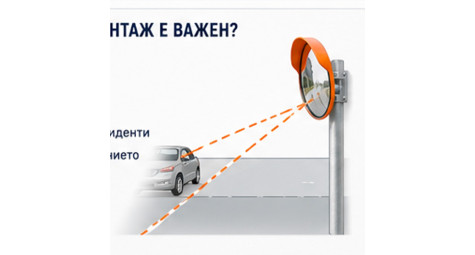
After installation, it is important to adjust the angle of the traffic mirror to achieve maximum visibility.
What viewing distance do traffic mirrors cover?
The viewing distance depends on the size of the traffic mirror.
- 45 cm – up to approximately 10 m;
- 60 cm – up to approximately 22 m;
- 80 cm – up to approximately 32 m;
- 100 cm – up to approximately 37 m.
Larger traffic mirrors provide a wider field of view and better visibility at longer distances.
Can a traffic mirror be mounted on a wall?
Yes. Some traffic mirror models support both pole mounting and direct wall mounting.
The models:
- DZ600-TR;
- DZ800-TR;
support:
- wall mounting;
- pole mounting;
- column mounting;
- structure mounting.
A wall-mounted traffic mirror is especially convenient for underground garages, warehouses, ramps, and facilities without a free-standing pole.
Which traffic mirror is the most suitable?
There is no universal traffic mirror that is the best solution for every situation.
For warehouses and industrial facilities, a polycarbonate traffic mirror is often the most practical solution.
For professional parking areas, public spaces, and intersections, an acrylic traffic mirror is often a more suitable option.
The correct choice depends on:
- the facility type;
- the viewing distance;
- traffic intensity;
- working conditions;
- the required reflection quality.