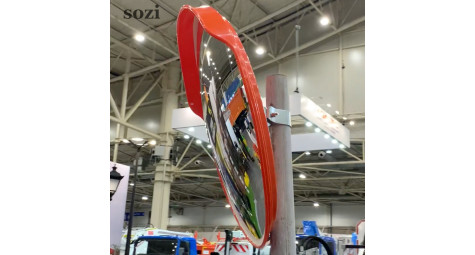


How to Properly Install a Traffic Mirror? Installation and Positioning Guide
How to Properly Install a Traffic Mirror?
Proper installation of a traffic mirror is extremely important for safety, visibility, and effective traffic control. Even a high-quality traffic mirror will not provide a good field of view if it is installed incorrectly, at the wrong height, or at an improper angle.
Many customers are looking not only for information on how to choose a traffic mirror, but also how to install it correctly — at what height, at what angle, on what type of pole, and in which exact position it should be mounted.
In this article, we will take a detailed look at how to properly install a traffic mirror, what the most common mistakes are, and how to achieve maximum visibility and safety.
Why Is Proper Traffic Mirror Installation So Important?
A traffic mirror must provide a clear view of the risk area. If it is installed too high, too low, or at the wrong angle, drivers will not be able to properly see approaching vehicles, pedestrians, or machinery.
A properly installed traffic mirror helps with:
- better visibility;
- safer maneuvering;
- faster reaction times;
- reducing the risk of accidents;
- better traffic control;
- monitoring blind spots.
Where Should a Traffic Mirror Be Installed?
A traffic mirror should be installed in a way that allows drivers to see the risk area before entering it.
Traffic mirrors are most commonly installed:
- at parking exits;
- on ramps;
- at intersections;
- in warehouse aisles;
- on internal roads;
- in industrial zones;
- at loading ramps;
- in areas with limited visibility.
It is important that the traffic mirror is positioned so that drivers can easily see it without taking too much attention away from traffic.
At What Height Should a Traffic Mirror Be Installed?
In most cases, a traffic mirror is installed at a height between 2 and 2.5 meters.
The exact height depends on:
- the type of facility;
- the size of the mirror;
- the height of vehicles;
- the viewing angle;
- the distance to the observation area.
In warehouses and industrial facilities, a traffic mirror is sometimes installed slightly higher because of forklift and heavy equipment traffic.
In parking areas and residential complexes, a standard height of approximately 2–2.3 meters is usually used.
At What Angle Should a Traffic Mirror Be Installed?
A traffic mirror should be directed in a way that provides the clearest possible view of the risk area without creating blind spots.
After installation, it is important to:
- sit inside the vehicle or forklift;
- check the actual field of view;
- adjust the mirror angle;
- make sure approaching traffic is visible;
- ensure there are no excessively large blind spots.
A properly adjusted traffic mirror should allow quick recognition of approaching vehicles, people, or machinery.