

How to Choose a Traffic Mirror? - SOZI Guide
How to Choose a Traffic Mirror?
Choosing the right traffic mirror is important for safety, good visibility and proper traffic organization in parking areas, warehouses, industrial facilities, intersections, ramps and zones with limited visibility. A properly selected traffic mirror helps prevent accidents, improves traffic control and makes maneuvering easier for cars, forklifts, trucks and other equipment.
Many customers search for a traffic mirror but are not sure which size is suitable, what the difference is between acrylic and polycarbonate, where the mirror should be installed and which model is the best choice for a specific site. In this article, we will explain in detail how to choose the correct traffic mirror depending on the installation area, viewing distance and operating conditions.
What is a traffic mirror?
A traffic mirror is a convex safety mirror designed to provide a wider field of view in areas with limited visibility. Most commonly, traffic mirrors are used at:
- intersections;
- parking and garage exits;
- underground parking areas;
- warehouses and logistics centers;
- loading ramps;
- industrial facilities;
- internal roads;
- blind spot areas;
- narrow passages and corners.
A convex traffic mirror allows drivers to see approaching vehicles, pedestrians or equipment before they enter the direct field of vision.
How to choose the correct traffic mirror size?
The size of the traffic mirror is one of the most important factors. The larger the mirror, the larger the visible area and the better the visibility from a greater distance.
When selecting a traffic mirror, it is important to consider:
- viewing distance;
- width of the monitored area;
- traffic speed;
- installation height;
- type of facility;
- traffic intensity.
450 mm traffic mirror
A 450 mm traffic mirror is suitable for:
- small garages;
- narrow passages;
- internal warehouse corridors;
- short distances up to approximately 10 meters;
- small parking areas;
- local observation points.
This size is a good solution for compact spaces where an extremely wide viewing angle is not required.
600 mm traffic mirror
A 600 mm traffic mirror is the most universal size and is most commonly used for:
- parking areas;
- ramps;
- garage exits;
- warehouses;
- residential complexes;
- internal roads.
A 600 mm traffic mirror is suitable for distances up to approximately 20–22 meters and is the best choice for most standard sites.
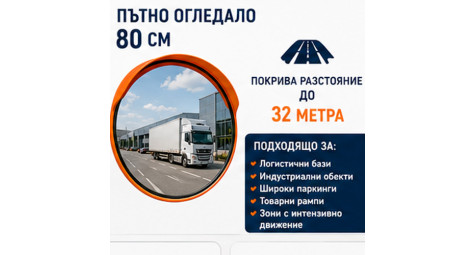
800 mm traffic mirror
An 800 mm traffic mirror is commonly used in:
- larger warehouses;
- logistics centers;
- industrial facilities;
- wider parking areas;
- loading ramps;
- areas with heavier traffic.
This size provides a wider field of view and is suitable for distances up to approximately 30–32 meters.
1000 mm traffic mirror
A 1000 mm traffic mirror is a professional solution for:
- large spaces;
- intersections;
- internal roads;
- production facilities;
- sites with heavy traffic;
- large industrial zones.
A 1000 mm traffic mirror is suitable for distances up to approximately 35–37 meters and provides maximum visibility.
What is the difference between a polycarbonate traffic mirror and an acrylic traffic mirror?
Many customers are unsure whether to choose a polycarbonate traffic mirror or an acrylic traffic mirror. Both types have different advantages and are suitable for different environments.
Polycarbonate traffic mirror
Polycarbonate traffic mirrors are:
- more impact-resistant;
- lighter in weight;
- more practical for industrial environments;
- suitable for warehouses and ramps;
- a cost-effective solution.
They are an excellent choice for facilities where there is a risk of mechanical impact or where multiple observation points need to be equipped.
Acrylic traffic mirror
Acrylic traffic mirrors provide:
- clearer reflection;
- better optical clarity;
- higher visual comfort;
- a more professional appearance;
- professional-grade image quality.
An acrylic traffic mirror is suitable for parking areas, public facilities, intersections, office buildings and professional infrastructure projects.
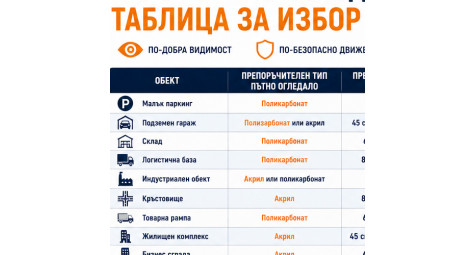
How to choose a traffic mirror according to the application?
Traffic mirror for parking areas
For standard parking areas, a 600 mm traffic mirror is most commonly used. For larger parking facilities or ramps, an 800 mm traffic mirror is more suitable.
If the parking facility is representative or has heavier traffic, an acrylic traffic mirror is a good choice.
Traffic mirror for warehouses
In warehouse environments, a polycarbonate traffic mirror is often the most practical solution because it is more resistant to daily operational conditions.
For narrow corridors, a 450 mm traffic mirror may be sufficient, while main traffic zones usually require 600 mm or 800 mm.
Traffic mirror for intersections
At intersections and external roads, larger models are usually used — 800 mm or 1000 mm. These provide better visibility over longer distances.
For such applications, acrylic traffic mirrors are often preferred because of their clearer reflection.
Traffic mirror for ramps
At ramps, underground garages and narrow turns, a 600 mm traffic mirror is most commonly used. If the ramp is wider or traffic is heavier, an 800 mm model is more appropriate.
Which mounting type should you choose?
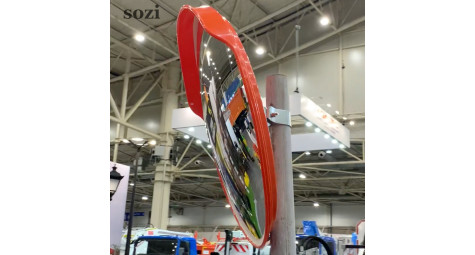
Traffic mirrors can be mounted:
- on poles;
- on pipes;
- on walls;
- on facades;
- on columns.
Some models allow universal mounting. For example, the DZ-600-TR and DZ-800-TR series can be mounted both on walls and on poles/pipes.
When selecting the mounting type, it is important to consider:
- the available structure;
- installation height;
- viewing angle;
- traffic direction;
- visibility toward the risk zone.
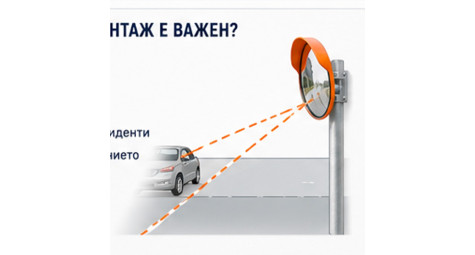
At what height should a traffic mirror be installed?
In most cases, a traffic mirror is installed at a height between 2 and 2.5 meters, depending on the facility and traffic type.
It is important that the mirror:
- is not installed too high;
- is not installed too low;
- has a direct view toward the risk area;
- is clearly visible to drivers.
How to choose the right traffic mirror?
To choose the correct traffic mirror, it is useful to answer several questions:
- Where will it be installed?
- What viewing distance is required?
- How heavy is the traffic?
- Is there a risk of mechanical impact?
- Is wall mounting required?
- How wide is the observation area?
After that, it becomes easier to determine:
- the size;
- the material;
- the mounting type;
- the appropriate model.
Why choose SOZI traffic mirrors?
SOZI offers professional traffic mirrors for parking areas, warehouses, intersections, logistics centers and industrial facilities. Our product ranges are selected and manufactured according to specifications for professional use.
SOZI offers:
- polycarbonate traffic mirrors;
- acrylic traffic mirrors;
- 450 mm, 600 mm, 800 mm and 1000 mm sizes;
- models for wall and pole mounting;
- solutions for B2B customers;
- professional consultation;
- international delivery.
Our goal is to provide not simply a traffic mirror, but the correct solution for safety, visibility and traffic control.
Traffic mirrors for international projects
SOZI supplies traffic mirrors for projects in logistics, industry, parking infrastructure, warehouses and commercial facilities across Europe.
If you are looking for a traffic mirror, parking mirror, warehouse mirror, intersection mirror, convex safety mirror or industrial visibility solution — SOZI offers professional products for improved visibility and safety.